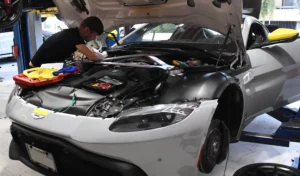
Built Different. Serviced Different.
Enzo Ferrari famously said, “I don’t sell cars; I sell engines. The cars I throw in for free since something has to hold the engines in.”
That wasn’t arrogance. That was philosophy. Every Ferrari starts with the engine and builds outward. The bodywork, the interior, the electronics — all of it exists to serve what happens between the cylinder heads. This approach creates machines unlike anything else on the road.
It also creates machines that general mechanics simply aren’t equipped to handle. Not because they lack skill. Because Ferrari engineering operates on different assumptions than what most shops encounter daily.
The Engine That Thinks

A Ferrari V8 or V12 isn’t just more powerful than a typical engine. It’s more precise. Tolerances measured in microns. Valve timing calibrated for high-RPM operation that would destroy conventional powerplants. Materials selected for specific thermal properties under extreme stress.
General mechanics learn on engines designed for reliability across wide operating ranges. Forgiveness is built in. Ferrari engines demand exactness. Wrong oil viscosity? Problems. Incorrect torque sequence? Problems. Generic diagnostic approach? You might fix one thing and create three more.
These engines communicate constantly through sensors and control units. Understanding what they’re saying requires experience with how Ferrari thinks about performance — not just how engines work in general.
Electronics From Another Planet

Modern Ferraris run on proprietary electronic architectures that share little with mainstream vehicles. The systems controlling traction, suspension, throttle response, and gearbox behavior all talk to each other in ways general diagnostic tools don’t fully comprehend.
A check engine light on a Ferrari might indicate something straightforward. Or it might be the first whisper of a cascade failure that requires understanding relationships between systems. General scan tools read codes. Ferrari-specific knowledge reads context.
We’ve seen cars come in after visits to general shops where the “fix” created electrical gremlins that took real expertise to trace and resolve. The initial problem? Sometimes minor. The aftermath? Expensive.
Materials That Demand Respect

Ferrari builds with aluminum, carbon fiber, magnesium alloys, and composite materials that behave nothing like the steel most mechanics train on. Each material has specific requirements for repair, handling, and even cleaning.
Carbon fiber doesn’t dent — it fractures, delaminates, or cracks in ways that require specialized assessment and repair techniques. We perform carbon fiber restoration because we understand composite structures. A general body shop might patch it. We actually fix it.
Aluminum panels need different welding approaches. Magnesium components require specific corrosion protection. Even cleaning these cars demands care — harsh chemicals can damage finishes and coatings that protect lightweight materials.
The Cost of Getting It Wrong

This isn’t about gatekeeping. It’s about consequences.
The most expensive path is often paying twice: guesswork repair, repeat failure, then specialist diagnosis from scratch. A general mechanic working on a Ferrari without proper knowledge might overtorque a bolt and crack an expensive casting. Use wrong thread sealant and cause a leak. Miss a calibration step and trigger limp mode. These aren’t hypotheticals — they happen.
We document findings with photos and video, right-size the scope, and verify every repair with proper diagnostic routines. That’s how you avoid replacing expensive assemblies when a smaller root cause is the true failure — and how you avoid paying for the same repair twice.
What Ferrari-Level Service Actually Looks Like
Our shop has worked on European exotics since 1976. Over the last three years alone, we’ve serviced 82 Ferraris — building the kind of pattern recognition and accumulated knowledge that only comes from doing this work daily, across generations of Ferrari engineering.
Our technicians average over 13 years of hands-on experience — specific expertise with vehicles that demand more, not general automotive experience. That depth shows in diagnostics: knowing what a Ferrari is telling you before the scan tool confirms it.
We use only OEM materials and methods. Liqui Moly synthetic oils meeting factory specifications. Dealer-level diagnostic platforms with access to factory service information. Dry ice cleaning for delicate surfaces. Carbon fiber restoration capabilities. A licensed spray booth for paint matching to factory standards.
The core difference comes down to three things: evidence-based diagnosis, properly scoped repairs, and verified results. Every finding documented. Every repair confirmed. No guesswork.
Warranty and parts policy
Every Ferrari repair is backed by our 2-year / 24,000-mile warranty covering all defects in materials and workmanship on parts and labor we supply — with a warranty claim rate of less than 1%. Re-inspections are always performed immediately and free of charge, without an appointment. We do not install customer-supplied parts. Wear items and consumables (including tires) are not covered.
What Ferrari owners say about our work
Your Prancing Horse Deserves a Specialist

If you’re in the San Fernando Valley — Reseda, Encino, Tarzana, Sherman Oaks, Calabasas, Woodland Hills — there’s a place that speaks Ferrari.
Your car was built by specialists. It should be serviced by specialists.