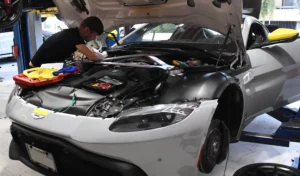
Bentley Continental GT, Flying Spur, Bentayga — these are engineered to a standard most shops aren’t equipped to meet. At European Auto Service in Reseda, we’ve serviced over 139 Bentley vehicles in the last three years, making us one of the most experienced independent Bentley repair specialists in Los Angeles.
Our BAR-licensed facility (ARD 295530) uses factory-level diagnostic platforms — including ALLDATA and Mitchell1 — to perform the kind of guided procedures Bentley engineering demands. Here are five Bentley repairs where that equipment and experience make a measurable difference.
1) Air suspension diagnosis and ride-height calibration

Bentley Continental GT and Bentayga use a multi-chamber air suspension system that relies on height sensors at each corner, electronic valve blocks, a dedicated compressor module, and control unit logic that adjusts in real time.
When a component is replaced — whether it’s a sensor, air strut, or compressor — the system requires a factory-level guided calibration through diagnostic software to relearn ride-height positions and recalibrate damper response. Without this step, the vehicle may sit unevenly, trigger suspension warnings, run the compressor continuously, or deliver a noticeably harsher ride than intended.
Generic scan tools can read fault codes, but they cannot perform the guided calibration routine — this requires manufacturer-capable diagnostic access that connects to the suspension control module directly. Our technicians perform this calibration as a standard part of every Bentley air suspension repair, verifying correct operation across all ride modes before the vehicle leaves the shop.
Common symptoms that bring Bentley owners in: uneven ride height after sitting overnight, repeated suspension fault warnings, compressor running audibly longer than usual, or a harsh ride that wasn’t there before.
2) Manufacturer-capable diagnostics beyond generic OBD

A fault code tells you where to look — not what’s wrong. Bentley electrical architecture is complex: a single symptom can involve multiple networked modules communicating through gateway controllers. A misfiring engine, for example, might trace back not to ignition or fuel delivery, but to a faulty signal from the camshaft position sensor being misinterpreted by the engine control module due to a software calibration issue.
Proper Bentley diagnostics go beyond reading codes. They require guided test routines that walk the technician through manufacturer-defined diagnostic sequences, live data monitoring across multiple sensor channels simultaneously, module adaptations that reconfigure control units after component replacement, and verification scans that confirm the repair resolved the root cause rather than just clearing the code.
At our shop, we use dealer-level diagnostic platforms with access to the same factory service information Bentley dealers reference — including wiring diagrams, technical service bulletins, and live data parameters. Our technicians average over 13 years of hands-on experience with European electrical systems, which means they know how to interpret diagnostic data in context, not just follow a flowchart.
3) Carbon-ceramic brake service (when equipped)

Carbon-ceramic systems demand careful handling and correct procedures. Mistakes can create noise, vibration, uneven wear, or damage.
4) Electrical architecture resets after battery or module work

Modern Bentley vehicles — Continental GT, Flying Spur, and Bentayga alike — run an extensive network of interconnected control modules. The engine ECU, transmission controller (TCU), body control module (BCM), adaptive chassis controller, park assist module, comfort/convenience systems, and infotainment gateway all depend on stable communication through the vehicle’s central gateway module.
When the battery is disconnected for a repair or a module is replaced, these systems lose their stored adaptations and learned parameters. If battery voltage drops below the minimum threshold during the process — or if the technician skips the required initialization sequence — the result is often a cascade of secondary faults that appear unrelated to the original repair:
- Window one-touch function stops working
- Seat memory positions reset or become unresponsive
- Adaptive suspension reverts to a default mode and no longer adjusts to driving style
- Steering angle sensor loses its calibration, triggering stability control warnings
- Tire pressure monitoring shows false alerts
- Start/stop system deactivates itself
This happens because Bentley’s electrical architecture requires each module to complete a handshake sequence with the gateway during initialization. If that sequence is interrupted or if the module doesn’t receive adequate voltage during the relearn process, it stores a fault and reverts to a limited operating mode.
The proper procedure requires maintaining stable voltage throughout the repair with a battery support unit, performing a controlled shutdown sequence before disconnecting power, and then running module-by-module initialization and relearn routines through diagnostic software after reconnection. Each module must be confirmed individually — the steering angle sensor, the window regulators, the seat modules, the climate control, the park assist calibration.
This is standard protocol at our shop for every Bentley repair that involves battery disconnection or module replacement. Preventing secondary faults takes 30–45 minutes of diagnostic time. Chasing them after the fact can take days.
5) Transmission adaptations after service

Bentley Continental GT and Flying Spur models use ZF 8-speed automatic transmissions (8HP series) that continuously adapt shift timing, line pressure, and torque converter lock-up behavior based on driving patterns. The transmission control unit (TCU) builds a learned profile over thousands of shift events — adjusting for clutch pack wear, fluid viscosity, and the driver’s throttle habits.
After a transmission fluid service, valve body repair, solenoid replacement, or mechatronic unit work, these learned adaptations no longer match the mechanical reality of the transmission. The TCU is still shifting based on the old fluid condition or the previous component’s behavior — which is why owners sometimes notice delayed shifts, harsh 2–3 or 3–4 engagement, torque converter shudder at low speeds, or a transmission that simply doesn’t feel as refined as it should.
A proper adaptation reset clears the TCU’s learned values through diagnostic software and restores factory-default shift maps. The transmission then relearns from a clean baseline — but this process isn’t instant. It requires a structured adaptation drive: a sequence of light-throttle upshifts, full-load kickdowns, highway cruising in converter lock-up, and parking maneuvers that exercise the reverse gear and the park lock actuator. Only after this drive can the technician verify via live data that shift times, pressures, and slip values are within factory specification.
Without this procedure, the transmission may eventually adapt on its own over hundreds of miles — but during that period, the driving experience won’t meet Bentley standards. In some cases, mismatched adaptations can trigger a fault that puts the transmission into limp mode, leading to an unnecessary second visit.
Our technicians perform adaptation resets and structured verification drives as part of every Bentley transmission service, confirming smooth shift quality across all gears and driving modes before delivery.
Why our scope often saves more than line-by-line pricing

We use photo and video documentation and evidence-based diagnosis to right-size repairs. We frequently see quotes that replace large assemblies when a smaller component is the true failure — or where a repair/rebuild option is reliable and more appropriate.
Compare your dealer quote
On comparable work — same scope, OEM-quality parts, manufacturer-correct procedures — our pricing is consistently lower than local Bentley dealer rates. Our labor rate for Bentley and other exotic vehicles is $220/hour, and every repair uses only OEM-specification materials and Liqui Moly synthetic oils that meet factory approvals. For a detailed line-by-line comparison of your dealer estimate, visit: compare your dealer quote.
Why Bentley owners in Los Angeles choose independent specialist service
After the factory warranty expires, many Bentley owners look for a trusted independent alternative to dealer service. The reasons are practical: shorter wait times, direct communication with the technician working on your car, and transparent pricing without dealership overhead.
At European Auto Service, owner John Soneff personally oversees every Bentley repair. That hands-on accountability – backed by our 2-year / 24,000-mile comprehensive warranty and our European specialization since 1976 – is the kind of reputation Bentley owners look for when making the switch from dealer service.
Bentley models we service in Los Angeles
Our Reseda facility provides full-service repair and maintenance for the complete Bentley range, including Continental GT, Continental GTC, Flying Spur, Bentayga, and Mulsanne. Whether your Bentley needs scheduled maintenance, complex diagnostics, engine or transmission repair, air suspension service, or brake work — our team has the experience and equipment to handle it at our BAR-licensed facility.
We serve Bentley owners across Reseda, Encino, Tarzana, Calabasas, Woodland Hills, Sherman Oaks, Beverly Hills, Santa Monica, and communities throughout the San Fernando Valley and Westside Los Angeles.
Warranty and parts policy
Every Bentley repair we perform is backed by our 2-year / 24,000-mile warranty covering all defects in materials and workmanship on parts and labor we supply — with a warranty claim rate of less than 1%. Re-inspections are always performed immediately and free of charge, without an appointment. We do not install customer-supplied parts. Wear items and consumables (including tires) are not covered.