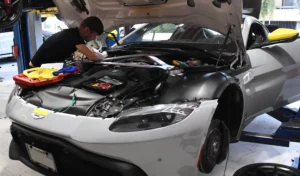
What 60,000 Miles Really Means for a Continental GT
The Continental GT was built for exactly this – eating miles. Since 2003, Bentley has produced over 100,000 of these grand tourers. They’re designed to cross continents in comfort, not sit in garages as investments.
So when one rolls into our shop with 60,000 miles showing, we don’t see a problem. We see a checkpoint.
Here’s what we actually find on Continental GTs at this mileage – the real patterns, not internet horror stories. Some items need attention. Others prove Bentley builds more reliability into these cars than people assume.
Air Suspension Components

This tops the list. Not because the system is poorly designed – it’s actually brilliant – but because it works constantly. Every bump, every corner, hundreds of adjustments per second.
Around 60,000 miles, air struts start showing their age. The rubber bladders develop microscopic cracks. Compressors work harder to compensate. You might notice the car “settling” overnight or sitting slightly uneven in the morning.
Replacement isn’t cheap – industry sources cite over $5,000 for a full air suspension overhaul. But catching it early, when just one strut needs attention, costs far less than waiting until the compressor burns out from overwork.
Ignition Coils and Spark Plugs

The W12 has 12 cylinders, 12 ignition coils, and – here’s the fun part – 48 spark plugs. Four per cylinder. That’s a lot of ignition events happening at 6,000 RPM.
By 60,000 miles, original spark plugs are due for replacement regardless. Coils often follow. Symptoms include subtle misfires, slightly rough idle, or a check engine light that comes and goes.
Sir Henry Royce once said, “The quality will remain long after the price is forgotten.” True for the engine itself – W12s are remarkably robust. But consumables are called consumables for a reason.
Coolant System Weak Points

The W12 runs hot. All that power concentrated in a compact package generates serious heat. Bentley engineered the cooling system to handle it, but some components have finite lifespans.
Plastic coolant fittings become brittle. Expansion tanks develop hairline cracks. Water pumps wear. We see these failures cluster around the 60,000-mile mark, often announced by a sweet smell from the engine bay or a small puddle in the garage.
The good news: catching a coolant leak early is straightforward. Ignoring it leads to overheating, and overheating leads to very expensive problems.
Electrical Gremlins
Modern Bentleys contain enough electronics to run a small office building. Hundreds of modules talking to each other constantly. Most of it works flawlessly for years.
But around 60,000 miles, little annoyances appear:
- Parking sensors that false-alarm or go silent
- Seat motors that move slowly or forget their positions
- Infotainment quirks that require a battery reset
- Door handles that hesitate before presenting
None of these strand you on the highway. They’re irritations, not emergencies. But they remind you that complex systems need attention from people who understand them.
What’s Usually Fine at 60K

Here’s the part that surprises people: the big stuff holds up remarkably well.
The ZF transmission is genuinely reliable. We rarely see internal failures. Fluid changes at proper intervals, and these gearboxes just keep working.
The W12 engine itself – when properly maintained – is what owners on enthusiast forums call “bomb proof.” Block, heads, internals… Bentley overengineered the fundamentals.
Body and interior quality remains exceptional. The leather ages gracefully. Wood veneers stay beautiful. Panel gaps stay tight. A 60,000-mile Continental often looks like it has half that mileage.
The Difference Maintenance Makes
Two Continental GTs with identical mileage can be completely different cars. The difference? Service history.
Full dealer or specialist service records every year, correct fluids, OEM parts – these cars feel fresh at 60,000 miles. Minor issues got caught early. Preventive maintenance prevented.
Skip services, use generic fluids, defer repairs – and 60,000 miles feels like 160,000. Problems compound. Small issues become expensive failures.
We back our work with a 2-year, 24,000-mile warranty. Our warranty claim rate runs below 1%. That’s not luck – it’s what happens when repairs are done correctly the first time.
Considering a High-Mileage Continental GT?

Don’t fear the odometer. Fear missing service records.
A Continental GT with 80,000 documented miles beats one with 40,000 mystery miles every time. These cars were built to be driven. Regular use keeps seals supple, fluids circulating, and systems functioning.
If you’re in the San Fernando Valley – Reseda, Encino, Sherman Oaks, Calabasas, Woodland Hills – we’re happy to inspect a Continental GT before you buy. Better to know what you’re getting into than to guess.