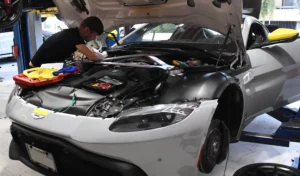
The Audi Sport Quattro is one of the rarest and most important cars ever to wear the four rings. Built between 1984 and 1986 in roughly 214 examples, it was created for one reason: to homologate Audi’s Group B rally programme. Audi needed a minimum production run of road cars to qualify the model for competition, and what arrived in showrooms was a short-wheelbase version of the standard Quattro – 320 millimetres shorter, fitted with a turbocharged 2.1-litre 20-valve five-cylinder engine, and built to a specification that placed it among the most expensive new cars in the world at the time.
When this 1983 example arrived at our Reseda shop, the brief covered mechanical service, full undercarriage attention, and a focused interior restoration including a seat-position modification the owner had been wanting for years. Every phase of this project was documented with photos and video – from initial diagnosis through final verification. That documentation drives our process: we measure before we decide, we photograph before we disassemble, and we verify before we deliver.

The challenge
A Sport Quattro is not a forgiving platform for partial work. Production numbers in the low hundreds mean parts knowledge is concentrated among a small group of specialists worldwide, and any modification has to respect what makes this car a collectible in the first place.
Initial scope discussion identified work across these areas:
- Engine: oil leak from the cylinder head gasket area, accessory drive belts aged
- Undercarriage: full inspection and service required across the entire underside
- Interior ergonomics: factory seat position too high for the owner’s driving preference – request to lower the seat mounting by approximately two inches
- Cabin floor: original floor in poor cosmetic condition, requiring restoration and refinishing from inside the cabin
- NVH: limited factory sound insulation, owner requested supplementary sound deadening as part of the interior work

Our approach
Before any teardown, we performed a systematic inspection to confirm what was failing, what was suspect, and what could only be evaluated after disassembly. This diagnosis-first approach prevents unnecessary work and ensures every line item is driven by evidence, not assumption. Each phase below was discussed with the owner before parts were ordered.
Phase 1: Diagnosis and scope definition
The Sport Quattro’s five-cylinder engine sits longitudinally in the front bay, ahead of the front axle line – typical Audi packaging for this period. We documented every system before disassembly: compression and leak-down on the inline-five, leak source confirmation at the head gasket, belt condition assessment, full underside inspection on the lift, interior tear-down planning, and a parts inventory for the cabin floor work. The findings shaped the scope and informed sourcing for the rare components a Sport Quattro requires.
Phase 2: Engine service – head gasket and belts
Confirming an oil leak at the cylinder head gasket on a 20-valve five-cylinder means cylinder head removal. The head was lifted for inspection, the deck surfaces cleaned and measured, and the gasket replaced with a factory-specification part. All accessory drive belts were replaced as a set, and the engine was refilled with Liqui Moly synthetic oil meeting Audi specification for this period.
This is a right-size scope decision that matters: the bottom end measured within specification, so the work stayed focused on what inspection actually showed – not a speculative full rebuild.

Phase 3: Full undercarriage service
With the car on the lift, the entire underside was inspected, cleaned, and serviced. On a four-decade-old homologation special that has lived hard, undercarriage condition is often the difference between a car that drives like its designers intended and one that does not. Drivetrain mounts, exhaust hardware, suspension components, brake lines, and protective coatings were all assessed and addressed where needed.

Phase 4: Seat mount modification
The factory seat position in a Sport Quattro is high – a consequence of the standard Audi 80 platform underpinnings, modified for rally use rather than for occupant ergonomics in a sports application. The owner had been driving the car with a seating position he wanted to refine, and asked us to lower the seat mounts by approximately two inches.
This is the kind of modification that requires careful execution: structural mount points need to remain safe and correctly load-bearing, seat travel and belt geometry need to remain functional, and the work has to be reversible if the next owner wants the car back to factory specification. We fabricated revised mounts that achieved the lower seating position while preserving all of those requirements.

Phase 5: Cabin floor restoration and refinishing
With seats and interior trim removed for the seat-mount work, the cabin floor was fully restored. Surfaces were cleaned, prepared, and refinished from the inside – the kind of work that is only possible with the interior properly disassembled, and one of the reasons combining floor work with seat modifications makes sense as a single scope rather than two separate visits.
Phase 6: Supplementary sound deadening
Factory sound insulation on a Sport Quattro is limited – this was a homologation car, and weight was the priority. With the interior already open, we added supplementary automotive-grade sound deadening across the floor and key panels. The result is a meaningfully quieter cabin without altering the car’s character or adding significant weight in places that would compromise the original engineering intent.
The results
After reassembly and verification – cold start, idle stabilisation, road test for engine behaviour, seat position confirmation in driving conditions, cabin acoustic check, and a full visual inspection of completed interior work – the Sport Quattro was ready for delivery. The engine runs without the head gasket weep that brought it in. The underside has been documented, serviced, and protected. The seating position now matches the owner’s preference while preserving the car’s structural and safety integrity. The cabin floor presents the way a car of this value should, and the supplementary sound deadening makes long drives meaningfully more comfortable.

Why choose European Auto Service for classic Audi Sport Quattro service
Specialized expertise
Our Reseda shop has been working on European vehicles since 1976. A car like the Sport Quattro – low-production, turbocharged five-cylinder, homologation-grade engineering – requires technicians who understand both the standard Audi platform of the period and the specific modifications that make this car what it is. Our technicians average more than 13 years of hands-on experience with European vehicles.
Evidence-based process
Every project follows the same discipline: diagnose before teardown, document with photos and video, scope the work from measurements rather than assumption, address supporting systems alongside the primary repair, and verify every result before delivery. The principle is simple – repair or rebuild where appropriate, replace where necessary.
Quality guarantee
Every repair, including classic homologation-special work, is backed by our 2-year / 24,000-mile warranty covering all defects in materials and workmanship. We do not install customer-supplied parts. Wear items and consumables (including tires) are not covered.
Classic European performance car services
Our team regularly works on vintage European performance vehicles including classic Audi Quattro and Sport Quattro; Lotus Esprit, Elise and Europa; classic Porsche 911 and 928; vintage Ferrari 308 and Dino; classic BMW M1, 2002 and E30 M3; Aston Martin V8 Vantage and DB models; and classic Jaguar E-Type and XJS. Learn more about our classic car restoration services. For owners requiring more extensive panel or paint work, our body and paint refinishing facility uses BASF Glasurit colour-matched systems and a seven-step polishing procedure.
What classic car owners say about our work
Looking for more? Read reviews from luxury and exotic car owners.
Ready to service or restore your classic European performance car?
Contact European Auto Service in Reseda to discuss your project. We serve classic car owners across the San Fernando Valley – Reseda, Encino, Tarzana, Woodland Hills, Calabasas, Sherman Oaks – and the greater Los Angeles area.