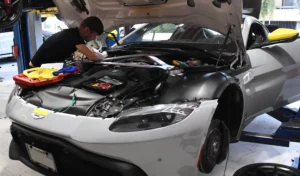
There is a reason Ferrari F355 owners put off major service. It is not the cost alone — it is knowing that doing it correctly means pulling the entire engine. On the F355, that is not a workaround. That is the procedure.
This is a walkthrough of a full major service we performed on a blue F355 here at our Reseda shop — what the job involves, why it is done this way, and what happens if it gets skipped.
Why the Engine Has to Come Out
On most cars, timing belt service is straightforward access work. On the Ferrari F355, the engine is mounted mid-rear and the camshaft seals and timing components are positioned in a way that makes proper service nearly impossible without full engine removal. Attempting to do the job in-car means compromised access, shortcuts on seal replacement, and timing set under conditions that leave no room for error.
The correct approach — the one Ferrari specifies — is engine out. It takes more time. It costs more. And it is the only way to do it right.
The Vehicle
Ferrari F355 | Mid-mounted V8 | California
The F355 was produced from 1994 through 1999 and is widely considered one of the finest Ferraris ever built — responsive, analog, and demanding of proper maintenance. The flat-plane V8 produces around 375 hp and is famous for its sound. It is equally famous for what happens when major service gets deferred: cam seal failure leads to oil contamination of the timing belt, and a contaminated belt on a non-interference engine still leaves you stranded. On some variants the consequences are worse.
This car came in due for full major service. No shortcuts requested, none taken.
Engine Removal

The rear clam and surrounding bodywork were removed and the entire drivetrain — engine and transaxle together — was extracted as an assembly and placed on a dedicated stand on the shop floor. The body was wrapped in protective film throughout the process to prevent any contact damage to the paint.
With the engine out, every component involved in the major service is fully accessible. This is the difference between doing the job and doing it properly.
Why the Engine Comes Out — Seen From Below

Once the drivetrain is out, the scale of the access problem becomes obvious. The engine bay of an F355 is compact and tightly packaged. Working the cam seals and timing components in-car would mean restricted angles, inadequate torque access, and no clean sight line for timing verification. Engine-out is not a preference — it is a requirement for work done to factory standard.
Work Performed

Timing Belt Replacement The existing timing belt was removed and replaced with a new unit. On the F355, this belt drives the camshafts directly and operates under high thermal stress from the mid-mounted V8. Ferrari specifies replacement intervals regardless of visible condition — the internal degradation that leads to failure is not visible on the surface.
Tensioner Replacement Both tensioners were replaced alongside the belt. Fitting a new belt on worn tensioners defeats the purpose — tensioner failure is a documented cause of belt-related incidents on these engines, and replacing them as a set is standard practice.
Camshaft Seal Replacement All camshaft seals were replaced. This is the primary reason the engine must come out. The F355 has four camshafts, each with its own seal, and seal degradation is a known characteristic of these engines as they age. Oil seeping past a cam seal contaminates the timing belt — a condition that can cause premature belt failure. With the engine on a stand, each seal is fully accessible and can be replaced cleanly with proper tooling.
Timing Set and Verification After assembly, timing was set precisely to factory specification. On a four-cam V8 with independent intake and exhaust camshafts per bank, timing accuracy is not a rough approximation — it directly affects power delivery, idle quality, and emissions. Each mark was verified before the engine was prepared for reinstallation.
Reassembly and Reinstallation The engine and transaxle were reinstalled, all connections restored, fluids filled to spec, and the car started and run through a warm-up cycle before final checks.
The Shop That Day

This is a normal Tuesday at European Auto Service. The F355 is on the lift with its engine on the floor. Behind it: an orange McLaren, a Rolls-Royce on the upper rack, and a black Ferrari in the adjacent bay. This is the environment where this work gets done — not a general repair shop that occasionally sees an exotic, but a facility where this is the daily workload.
What Happens If You Skip It
The F355 major service interval is typically every 3 years or 30,000 miles — whichever comes first. The consequences of deferral are well-documented in the Ferrari community:
- Aged cam seals begin to weep oil onto the timing belt
- Belt condition degrades faster than the interval would suggest
- A failed belt on an F355 means a stranded car at minimum, and potential engine damage depending on the variant and failure mode
Major service on an F355 is not optional maintenance. It is the cost of ownership done correctly.
Closing

European Auto Service has performed major service on Ferrari vehicles across the F355, 360, 430, and other platforms. Over the past three years, our team has worked on 80+ Ferrari vehicles in the Los Angeles area. The engine-out procedure on the F355 is one we have done many times — the process is documented, the tooling is correct, and the timing verification is done to factory specification every time.
All work is backed by our 2-year / 24,000-mile warranty on parts and workmanship.