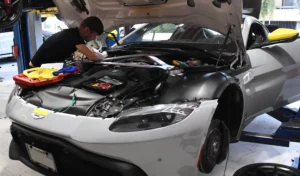
The Lamborghini Diablo is not a car you half-restore. Produced from 1990 to 2001, it was the last Lamborghini developed entirely under the original Sant’Agata philosophy before the Audi acquisition — a raw, dramatic, mid-engined supercar built around a 5.7-liter V12 producing up to 595 hp in later variants. When one arrived at our Reseda shop in partially disassembled condition, the scope of work was clear: do it completely, or don’t do it at all.
This is a breakdown of the full restoration process — engine, fuel system, body, and chassis.
The Vehicle
Lamborghini Diablo | V12 5.7L | Mid-engine, rear-wheel drive
The car arrived already partially stripped — previous work had been started elsewhere before the project came to us. Our team took over from that point, assessed what had been done, and completed the restoration across all systems.
Engine Assembly and Sealing

The Diablo’s V12 is a longitudinally mounted unit positioned ahead of the rear axle. Reinstalling it correctly requires an engine crane, precise alignment, and careful torque sequencing across dozens of fasteners. The engine had already been removed when the project came to us — our work began with inspection, sealing, and assembly.
Every gasket, seal, and O-ring in the engine was replaced as a matter of course. On a car of this age, rubber components degrade regardless of mileage — original seals on a Diablo are now 25 to 35 years old. Installing new seals throughout is not optional maintenance, it is the baseline for a reliable build. A specialist bearing was sourced and installed to factory specification.
Fuel Injector Service
The Diablo uses a multi-throttle body induction system with individual injectors per cylinder. At this age, injectors accumulate deposits and internal wear that affect spray pattern, flow rate, and ultimately power delivery and idle quality. Rather than replace them outright — a costly option given Diablo-specific parts pricing — all injectors were removed and sent to a specialist shop for professional rebuild.
Rebuilt injectors were tested, flow-matched, and reinstalled. This approach restores factory fuel delivery characteristics at a fraction of the cost of new units, and on a car with this level of mechanical complexity, correct fueling is foundational to everything else working properly.
Engine Reinstallation

With the engine fully assembled and sealed, reinstallation was carried out using a 1-ton engine crane. Two technicians managed the process — one operating the crane, one guiding alignment at the chassis mounts. The Diablo’s mid-engine architecture leaves minimal clearance during installation, and correct positioning before the engine contacts the mounts is critical to avoid damage to surrounding components and wiring.
All connections — fuel, coolant, electrical, exhaust — were restored and inspected before the engine was considered complete.

Full Body Respray
For a complete respray to be done correctly, the car needs to come apart. Panel gaps, door shuts, engine lid fit — none of these can be properly painted in assembly without masking compromises that show in the finished work. The Diablo was fully stripped before paint, ensuring every surface received consistent coverage and the finished result met the standard this car deserves.
Color and process details are available on request for owners considering a similar scope of work.
Underbody Skid Plate Restoration
The Diablo runs a metal underbody protection plate that takes the worst of what the road delivers — road debris, moisture, and over decades, corrosion. This car’s plate had rusted through in areas and lost structural integrity in sections.
The restoration process:
- Full rust removal and surface preparation
- Weld repair to restore structural integrity where material had been compromised
- Geometry correction to restore correct fit
- Primer and finish coat to factory specification
This is not glamorous work. It is also not optional on a car being returned to active use — a compromised skid plate on a car with this ground clearance is a mechanical liability.
What This Project Represents
European Auto Service has worked on 42+ Lamborghini vehicles over the past three years — including Diablos, Gallardos, Huracan, and Aventador. The Diablo specifically requires familiarity with parts sourcing that falls outside normal channels: specialist bearings, rebuilt injectors, body components that are no longer in production. Our team navigated that sourcing as part of the standard project workflow.
All work performed at European Auto Service is backed by our 2-year / 24,000-mile warranty on parts and workmanship.